Showing posts with label hero fantasy. Show all posts

Saturday, December 5, 2015

Book Review: Abomination by Gary Whitta

First, a big thank you to Inkshares*and the author for sending out a review copy.

Gary Whitta turns from screenwriting to print in his debut historical fantasy meets horror novel, Abomination. You might recognize his name from The Book of Eli and/or upcoming Star Wars projects. I confess that I didn't (I never saw that movie, and Star Wars is too much of mishmash of talent for me to notice names), but I was intrigued by the concept and the cover right from the start.

Here's the (modified) synopsis from Goodreads:

"Wulfric is England's greatest knight, but when he is called back into service to combat a plague of monstrous beasts known as abominations, he meets a fate worse than death and is condemned to a life of anguish, solitude, and remorse.

Indra is a fierce young warrior, raised among an elite order of knights. Driven by a dark secret from her past, she defies her controlling father and sets out on a dangerous quest to do what none before her ever have—hunt down and kill an abomination, alone.

When a chance encounter sets these two against one another, an incredible twist of fate will lead them toward a salvation they never thought possible—and prove that the power of love, mercy, and forgiveness can shine a hopeful light even in history’s darkest age."
Sound weird? It is - but in the best possible way. Abomination truly stood out from every fantasy novel I've read in the past few years. The story was unique, the characters were fun, and the focus on a "familial" bond instead of a romantic one was a smart choice.

However, Abomination does start off a bit slow. The first few chapters are exposition heavy, with a lot of background story and characters to establish. The actual "story" of the book begins fifteen years after the abominations have been unleashed on England. That is when we meet Indra - a teenage warrior girl who is determined to kill an abomination single-handedly and prove herself worthy to join the Order (the elite knights who hunted down abominations in the 15 year interim). Indra is stubborn and foolish and utterly loveable, with her twin swords and her single-minded pursuit of something that is terribly dangerous.

Wulfric, our other main character, has gone from a celebrated warrior to a hunted man who only longs for death. Indra shakes up his world, and he starts to feel protective and interested in another human being for the first time in fifteen years. But this puts Indra (and Wulfric) in terrible danger.

It's hard to say much more without spoilers (though the spoilery things are very obvious once you start reading), but I'll still give you my 5 reasons to read Abomination.

1. The concept. Hello, it's basically The Wolfman meets Vikings, but with sinister magic and a strong heroine. I don't know about you, but he had me right there.

2. Indra. I loved her. She's a teenage girl with epic sword skills and an attitude - but both of those elements make perfect sense in context. Indra was raised by warriors, trained by warriors, and considers herself a warrior, but she's untried and discounted by the men around her. And despite her skills, she's a believable young woman with flaws, weaknesses, and insecurities.

3. Great action. Abomination was a bit gory (though light on it for a horror novel), but the fight and action scenes leapt off the page. I felt like I was reading a movie (no surprise, considering the author's film background). And although Abomination would make an awesome movie, I never felt like a movie would have been a better vehicle for the story.

4. King Alfred + fantasy is a winning combination. The ravaged setting of Britain under Viking threat was perfect for the story. It provided a real-world anchor as well as compelling motivations for all of the main characters.

5. The themes. For a violent and often dark story, the overall messages were both touching and redemptive. Nothing was magically fixed or better at the end, but the emphasis on mercy, selfless love, loyalty, courage in spite of terrible odds, and hope, made Abomination a welcome change from many of the books I've read recently.

Overall: 4 out of 5 stars. Though it starts off a bit shaky, the last two thirds of Abomination tell a brutal but redemptive story of familial love and courage that will appeal to both horror** and fantasy readers. And it's a whole lot of fun.


Footnotes:

*Believe it or not, I had no idea what Inkshares was before I received this book at work. It's a really cool publishing project that combines crowdfunding with novel pitching, and it's an awesome idea. The link is at the top of this review if you want to check it out (if you're an aspiring author, you should definitely click it).

**I use horror in a loose, more genre sense. While there was a lot of fantasy/sword/monster violence, and quite a bit of flying gore, Abomination was only a 5 or so on the Creepymeter.

Wednesday, August 26, 2015

Mini Book Reviews: Moribito 1 and 2 by Nahoko Uehashi

I have never seen the anime Seirei no Moribito (Moribito: Guardian of the Spirit), but I randomly picked up the first novel several years ago. I loved how unique it was, but I only got around to the second one this week. I actually liked the second one, Guardian of the Darkness, even better. If you are interested in Japanese folklore, manga and/or anime, or strong heroines, then read on.

Moribito: Guardian of the Spirit (Moribito #1) by Nahoko Uehashi

Spectacular, isn't it? 
Covers and blurbs are from Goodreads.com:

Balsa was a wanderer and warrior for hire. Then she rescued a boy flung into a raging river -- and at that moment, her destiny changed. Now Balsa must protect the boy -- the Prince Chagum -- on his quest to deliver the great egg of the water spirit to its source in the sea. As they travel across the land of Yogo and discover the truth about the spirit, they find themselves hunted by two deadly enemies: the egg-eating monster Rarunga . . . and the prince's own father. 

I don't remember when my love of Japanese culture and history developed (I just know I was really little, and that it was probably brought on by a book of Japanese folktales). I read every book on samurai and ninja that my childhood librarians could find, and then I went on to books about Japan itself and its fascinating history. Next came the (inevitable) calligraphy, kanji, and manga.

So with all that as a preface, I was poised to love Moribito. But there's a lot more to like about this novel than the setting.

Let's start with Balsa. She's thirty years old, a wandering warrior and spear-for-hire. Not only is she a (believably) proficient fighter, she's also a humble, kind woman with a lot of heart. Her backstory may be tragic, but she hasn't let it hold her down. Just read this description:
“Balsa seemed invincible, endowed with powers no other warrior could match, but in her profile he could glimpse the shadow of a young girl, hurt and buffeted by a cruel and hopeless fate. If he had never experienced what it was like to be at the mercy of fate himself, he would not have noticed, but now he could see it with unbearable, heartrending clarity.” 
― Nahoko UehashiMoribito: Guardian of the Spirit
In Guardian of the Spirit, Balsa's travels find her in the island kingdom of Yogo. She saves the crown prince from a "freak"accident, which gets Balsa involved in something much bigger than she realized. Prince Chagum has a secret: he carries the great egg of the Water Spirit, which he must deliver to the northern sea. This has made him the target of an egg-eating monster and his own father. Chagum's mother rightly suspects the king, and she hires Balsa to protect the young prince. On the way, Balsa and Chagum develop a delightful relationship, a cross between mentor-student and siblings. Naturally, there is a lot of action, as a lone warrior woman attracts both interest and suspicion, and Balsa truly enjoys a fight.

The writing is lovely, but narrative heavy. The pacing and storytelling also differ from a typical Western novel. Its not a challenging read, but there are thought-provoking explorations of everything from gender roles to philosophical and religious differences in cultures. Also, this is one of the better translated novels I've read (applause for translator Cathy Hirano), and there are superb illustrations by Yuko Shimizu.

Overall: 4 out of 5 stars. In short, Moribito: Guardian of the Spirit is a breath of fresh air in the fantasy genre, with a unique heroine and an action-packed story that will appeal to guys, girls, teens, and adults.


Moribito II: Guardian of the Darkness (Moribito #2) by Nahoko Uehashi

"Conflict seems to follow those who learn to fight. If I could, I would spare you a life of bloodshed. But I have no choice."
― Nahoko UehashiMoribito: Guardian of the Darkness

Blurb and cover from Goodreads.com:
Balsa returns to her native Kanbal to clear the name of Jiguro, her dear mentor, who saved her life when she was six years old. But what should be a visit of truth and reconciliation becomes a fight for her life when she learns that Jiguro had been a member of King Rogsam's personal bodyguard. After Jiguro fled Kanbal with her, Rogsam sent the other bodyguards after them one by one--Jiguro's best friends, whom he had to kill to protect Balsa. Now, with the help of two Kanbalese children, Balsa must unwind the conspiracy surrounding Jiguro and the mystery of the Guardians of the Dark. 
If anything, Uehashi's strengths as a worldbuilder are even stronger with the second Moribito installment. The layers to her fantasy landscape keep peeling back for even more fascinating elements to be revealed. Oh, and there is a lot more food description in this one. It made me hungry.
Guardian of the Darkness takes up where Guardian of the Spirit left off, as Balsa
heads home to clear her beloved mentor's name. On the way, she saves another child (a pair of children, actually) from a fearsome cave spirit. This good deed ends up causing Balsa heaps of trouble, as she realizes that the events of her childhood were farm more nuanced and sinister that she imagined. Despite her best efforts, Balsa finds herself dragged into plots and intrigue, and a fight for her life and that of her nation.

Again, there is a lot of narrative, and the story has a rapid clip. However, the real reason to read this is Balsa herself. Her history is explored a little more, as well as her feelings and motivations. She is an incredible heroine that you can both empathize with and root for. And she is so very cool.

As a side note, the treatment of Jiguro (Balsa's mentor), his family, and the collateral damage his leaving caused, were all very well done.

Overall: 4 out of 5 stars. Another strong entry with great action, an awesome lead, and an exciting fantasy landscape.


And here's my biggest complaint:  the eight other books in the series have never been translated into English! Just another reason I should learn Japanese, I guess . . .*
But don't let that disappointing fact stop you from reading these two novels! They work just find as stand alone works.


Here's a challenge for you: off the top of your head, can you name any Japanese MG or YA novel that has been translated for English speakers? If you can, tell me in the comments so I can go find it. Have you read Moribito, or seen the anime?

Footnotes:
*I wish I was one of those people that languages clicked with. Alas, that is not the case. My language abilities are embarrassing at best . . . really bad for a writer, you know?


Monday, May 11, 2015

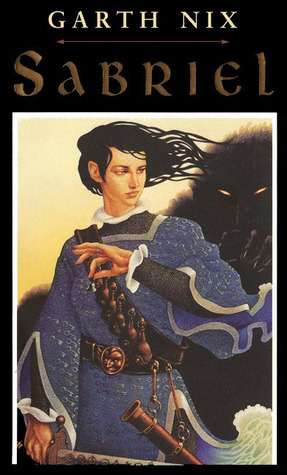
Happy 20th Anniversary Sabriel! #SabrielDay

“Death and what came after death was no great mystery to Sabriel. She just wished it was.” Sabriel, Garth Nix

20 years ago, Garth Nix published Sabriel, an incredible fantasy novel about a girl who is destined to put the dead in their place and save her world. Pretty awesome, right? 

I didn't stumble across Sabriel until I was almost eighteen.* I was going through a fantasy "dry spell,"as I call them, and I purchased Sabriel on a whim at an indie bookstore. 

I didn't know what to expect, but I had re-read The Hero and the Crown for (possibly) the twentieth time, and The Lord of the Rings trilogy for the eighth or so time, and I had started and stopped so many new fantasy novels in between. I was starting to think I'd read every awesome fantasy novel ever, and that no books were going to get me like my favorites again.**

So I picked up Sabriel with zero expectations It had the cover at right--> which is pretty cool, and (bonus) has  a fully and functionally clad female character on the front!

From the opening paragraph, where Sabriel brings a friend's rabbit back from death, I was hooked. I read the book in one sitting, ignoring food, vacation activities, and everything else, absorbed in the Old Kingdom and invested in the characters.

When I was done, I shoved it into my younger sister's hands and told her she had to read it too, so we could discuss it. When I got back from vacation, I did the same to my friends.

And then it wasn't until years later, when I took a job at an indie bookstore, that I met anyone else who had heard of/read Sabriel. I have been doing my tiny part to fix that ever since.

So what is it about Sabriel that makes it so good? This is something I ask myself every time I read a book and love it that much. I'm a writer as well as a reader, and I study my favorites in hopes of someday writing a book that affects someone else in the same way.

“Does the walker choose the path, or the path the walker?” Sabriel, Garth Nix.

Sabriel has a young heroine with untapped powers and an intimidating destiny-typical epic fantasy material-but there is a lot more here.So this doesn't get even soppier and meander everywhere, I'll summarize in a list:

My 5 Favorite Things About Sabriel (a.k.a. 5 reasons you should read it)

  1. Sabriel herself. I related to this serious, responsible girl with a deep love for her father, commitment to duty, and drive to do her best as the world gets crazier around her. And she is an Abhorsen (basically an anti-necromancer) which is, in my opinion, one of the coolest "powers" of any character ever.
  2. The magic system. Fantasy is and always will be my first love as a reader/writer, so I have read a lot of books with magic. The ancient Charter magic/innate power, binding words, and most of all, the bells, are an intricate, beautiful web of magic that feels natural.
  3. The world. The Old Kingdom seems to be dripping with history. You feel like you are barely scraping the surface of something ancient and fascinating. The other books in the series explore the world a bit more, but still leave you wanting to know more of the lore and geography. It is a fantasy world in the best since, familiar enough to be believable, and fantastic enough to lose you in it.
  4. Mogget and Touchstone.*** As "sidekicks" go, these two make great foils for Sabriel. Touchstone, far from just being a plot device or just the love-interest, is a dry, bitterly funny character in his own right. And Mogget manages to walk the fine line between hilarious and creepy, with his sarcasm and sinister undertones. And he's in the form of a white cat. (When Sabriel first rescues Touchstone is one of the funniest parts of the book.)
  5. The Abhorsens. They are basically silencers for the dead (or as above, anti-necromancers). Using their bells and Charter magic, they basically keep the balance, so that the dead stay dead. Death, in the world of Sabriel is made up of 9 precincts before a final gate. Abhorsens (at varying degrees of personal risk) can cross the borders of life and death to enter the river of Death. Sabriel inherits this position (eventually) from her father, who is mainly referred to as "the Abhorsen"in the book. This doesn't really tell you how cool the Abhorsens are, so you'll have to read and find out

I could go on, but I want you to actually read Sabriel if you haven't already. If you like high fantasy, strong heroines, or interesting magic systems, Sabriel is a must-read.

So, have you read Sabriel or anything else by Garth Nix? What is your favorite female fronted fantasy novel?

-R

Footnotes:
*Coincidentally, Sabriel's age ;)
**It was a bit naive of me, but still, it gets harder and harder to find books that are so absorbing.
***One of several subtle nods to Shakespeare. A bard geek like me gets excited about things like that.


Thursday, April 2, 2015

#TBT-Book Review: The Blue Sword

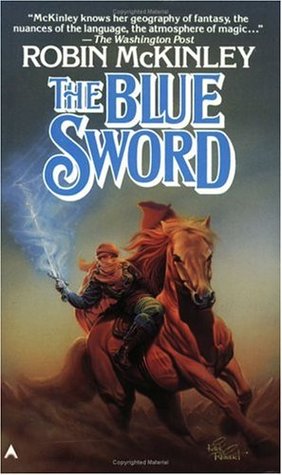
So, continuing on with book reviews, I decided to do a review of one of my all-time favorite books, The Blue Sword, by Robin McKinley.

Sometimes I reread a book I read as a kid/teenager and reevaluate it. Sometimes this turns out to be a mistake, but never when I read Robin McKinley.

My first experience with her books was when I was around eleven, and probably too young to really grasp all the nuances and complexities of her writing. I read The Hero and the Crown because the cover had a red-haired girl* wielding a sword, on a horse, facing a dragon. To a Lord of the Rings and Star Wars girl, this was all the incentive I needed to pick it up. I was drawn in by Robin McKinley's lyrical prose and her fascinating fantasy landscape. Naturally, after Hero, I picked up The Blue Sword, which gets me to today's review:

This is the cover of my copy. It is one of the better fantasy covers out there, in my opinion
In The Blue Sword, the recently orphaned Harry Crew arrives in the mysterious desert land of Damar to live on the generosity of her brother's friends. Awkward, too tall, and not really proficient at anything, Harry is restless and drawn to the strangeness of the desert around her. Her people (the Homelanders-very much like the English in Imperial India), have an uneasy hold on the wild territory around them, and an innate suspicion of their close neighbors, the Free Hillfolk (they resemble Bedouins, with magic powers, and they are awesome).
  When the king of the Free Hillfolk, Corlath, comes to ask the Homelanders for help again their mutual enemy, the Northerners, it sets things in motion that neither Homelanders or Hillfolk could imagine.

  Corlath (and some of the Hillfolk) have a sort of innate magic, or kelar, which grows stronger with emotion. As the heroine and protagonist, Harry also has this kelar, and finding out the how and why is part of the plot, so I won't spoil it. Suffice it to say that Corlath's kelar often "demands" he do strange or rash things: in this case, it tells him he needs to take Harry for the Hills. Harry's destiny is tied to both Homelanders and Hillfolk, and ultimately she must reconcile both those sides of herself, and bridge the way for others if they are to defeat the Northern hordes. If she becomes an awesome, legendary-sword wielding hero while still retaining her personality and identity, then you know you are reading a Robin McKinley novel.

What works/what I liked:

1. Harry. I can relate to her, you can relate to her, and she's authentic (minus the kelar, of course). She is a strong female character who is defined by her own personality, and acts like a real person.**
2, Robin McKinley's style and sly humor. Her use of language is lovely and easy to read. She is neither flowery or bare with her description. She never writes down to her readers, and there is no instant gratification. Her books are not typical YA.
3. Hillfolk culture. They are warriors, they use swords, they are proud and honorable, they have a wonderful relationship with their horses and other animals, and I could go on. I only wish there was more.
4. True Hero Fantasy. The Blue Sword is the real deal. Hero fantasy, as a genre, follows a young hero/chosen one from their usually unremarkable start, follows their training for greatness, and then establishes them by testing their skills/powers/heart, etc. Sometimes is is refreshing to read a book that isn't trying to be too clever.
5. Harry and Corlath's relationship. From prisoner/guest and reluctant kidnapper, to rider and king, to *spoiler* couple, they are one of my favorite fictional pairs. They manage to be equals (though Corlath is a king and Harry has the disadvantage), have disagreements, and be friends in a way that sold me. I am not a romance person, and honestly, The Blue Sword  has very little romance, but I found their relationship both compelling and believable.

What didn't work/what I didn't like:

This is harder, like critiquing your friend, but here goes:

1. (See #3 above) I wanted more Hillfolk. More culture, more history, more character development outside of the main ones. I could probably read a whole book about Damar's history and not be bored.
2. (See #4) Like most hero fantasy, Harry gains a lot of her powers/abilities through it being her destiny to have them. I know I said this was one of the best parts above, but it is also one of the things I don't like as much. Harry's time training and developing her powers is not long enough, and I would have liked to see it be harder. (It's not easy, per se, but, well . . .)
3. More Aerin. I know this is why you read Hero, but in my opinion, both books could use more of that legendary figure :) After all, Hero ends with the beginning of her legendary period.
4. More Corlath. Obviously, this is Harry's story, but I love Corlath, and I would have liked to know more about him. We know the essentials (like Harry does), but he is funny and grim, and fascinating, and a great character in his own right.
5. The Northerners. They are bad, mysterious, and witchy, and they want to destroy everything, but we really don't know much more. I know this is explored elsewhere, but I would have liked to know more about them.

Overall: 4.5 out of 5 stars-It isn't as good as Hero, but it is still one of my favorite books ever!

This was actually kind of hard!

Footnotes:

*I love red hair. Always have. And sometimes cover art is accurate.
**I do not like heroines who become strong by basically acting like a man. I also don't like period piece heroines who internally rant about the unfairness of their period-correct pastimes/clothing/mores in a modern fashion. It isn't realistic, and it isn't fair to the many strong women who have lived and died in the past. That's all.

Thanks for reading, and feel free to add books you reevaluated from childhood in the comments.