Showing posts with label Abhorsen. Show all posts

Monday, May 11, 2015

Happy 20th Anniversary Sabriel! #SabrielDay

“Death and what came after death was no great mystery to Sabriel. She just wished it was.” Sabriel, Garth Nix

20 years ago, Garth Nix published Sabriel, an incredible fantasy novel about a girl who is destined to put the dead in their place and save her world. Pretty awesome, right? 

I didn't stumble across Sabriel until I was almost eighteen.* I was going through a fantasy "dry spell,"as I call them, and I purchased Sabriel on a whim at an indie bookstore. 
I didn't know what to expect, but I had re-read The Hero and the Crown for (possibly) the twentieth time, and The Lord of the Rings trilogy for the eighth or so time, and I had started and stopped so many new fantasy novels in between. I was starting to think I'd read every awesome fantasy novel ever, and that no books were going to get me like my favorites again.**

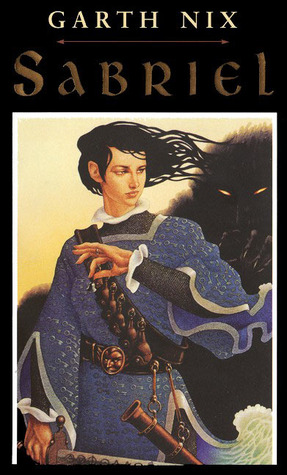
So I picked up Sabriel with zero expectations It had the cover at right--> which is pretty cool, and (bonus) has  a fully and functionally clad female character on the front!

From the opening paragraph, where Sabriel brings a friend's rabbit back from death, I was hooked. I read the book in one sitting, ignoring food, vacation activities, and everything else, absorbed in the Old Kingdom and invested in the characters.

When I was done, I shoved it into my younger sister's hands and told her she had to read it too, so we could discuss it. When I got back from vacation, I did the same to my friends.

And then it wasn't until years later, when I took a job at an indie bookstore, that I met anyone else who had heard of/read Sabriel. I have been doing my tiny part to fix that ever since.

So what is it about Sabriel that makes it so good? This is something I ask myself every time I read a book and love it that much. I'm a writer as well as a reader, and I study my favorites in hopes of someday writing a book that affects someone else in the same way.

“Does the walker choose the path, or the path the walker?” Sabriel, Garth Nix.

Sabriel has a young heroine with untapped powers and an intimidating destiny-typical epic fantasy material-but there is a lot more here.So this doesn't get even soppier and meander everywhere, I'll summarize in a list:

My 5 Favorite Things About Sabriel (a.k.a. 5 reasons you should read it)

  1. Sabriel herself. I related to this serious, responsible girl with a deep love for her father, commitment to duty, and drive to do her best as the world gets crazier around her. And she is an Abhorsen (basically an anti-necromancer) which is, in my opinion, one of the coolest "powers" of any character ever.
  2. The magic system. Fantasy is and always will be my first love as a reader/writer, so I have read a lot of books with magic. The ancient Charter magic/innate power, binding words, and most of all, the bells, are an intricate, beautiful web of magic that feels natural.
  3. The world. The Old Kingdom seems to be dripping with history. You feel like you are barely scraping the surface of something ancient and fascinating. The other books in the series explore the world a bit more, but still leave you wanting to know more of the lore and geography. It is a fantasy world in the best since, familiar enough to be believable, and fantastic enough to lose you in it.
  4. Mogget and Touchstone.*** As "sidekicks" go, these two make great foils for Sabriel. Touchstone, far from just being a plot device or just the love-interest, is a dry, bitterly funny character in his own right. And Mogget manages to walk the fine line between hilarious and creepy, with his sarcasm and sinister undertones. And he's in the form of a white cat. (When Sabriel first rescues Touchstone is one of the funniest parts of the book.)
  5. The Abhorsens. They are basically silencers for the dead (or as above, anti-necromancers). Using their bells and Charter magic, they basically keep the balance, so that the dead stay dead. Death, in the world of Sabriel is made up of 9 precincts before a final gate. Abhorsens (at varying degrees of personal risk) can cross the borders of life and death to enter the river of Death. Sabriel inherits this position (eventually) from her father, who is mainly referred to as "the Abhorsen"in the book. This doesn't really tell you how cool the Abhorsens are, so you'll have to read and find out

I could go on, but I want you to actually read Sabriel if you haven't already. If you like high fantasy, strong heroines, or interesting magic systems, Sabriel is a must-read.

So, have you read Sabriel or anything else by Garth Nix? What is your favorite female fronted fantasy novel?

-R

Footnotes:
*Coincidentally, Sabriel's age ;)
**It was a bit naive of me, but still, it gets harder and harder to find books that are so absorbing.
***One of several subtle nods to Shakespeare. A bard geek like me gets excited about things like that.


Tuesday, April 21, 2015

Top 10 Tuesday via Broke and Bookish: Favorite Authors (with gifs)

And it's Tuesday-which means Top 10 Tuesday with the lovely people over at The Broke and the Bookish. Every week, they pick a theme for a top 10 list, and participating bloggers link back. You can find out more here.
This week's top 10-Top 10 Favorite Authors, was excruciating . . .
I know, Emma, I know.
Rather than agonize, grit my teeth, and lament, I decided to list 5 of my favorite "contemporary"* authors and 5 favorite "classic" authors, with two requirements:
  1. I have to have read at least 2 books by them
  2. I have to have reread at least 1 of their books/plays/whatever
Otherwise, this post might have taken me a couple years of re-reading and soul-searching.
But it all seriousness, this is really hard. So no more stalling, here it is:

 
  1. Classic: J. R. R. Tolkien
  2. Contemporary: Robin McKinley

I put them together because they are two of my earliest reading/writing influences. My dad read The Hobbit to us when we could hardly read ourselves (Thank you Dad!). Though some of the subtleties in Tolkien’s writing certainly escaped me as a kid, the beauty never did. I 100% blame him for my obsession with elves, my fascination with forests, and my dissatisfaction with so much of modernity.

Likewise, when I first read The Hero and the Crown, I was hooked. McKinley’s lovely use of language, her dreamy worlds, and her truly awesome heroines are still my favorite. As a teenager, I felt like her characters “got” me.

3. Classic: William Shakespeare
4. Contemporary: Neil Gaiman

Ah, Shakespeare; love him or hate him, or doubt he wrote his plays: I don’t care. He is hailed as the greatest writer in the English language for a reason. From made up words, to memorable characters, to owning tropes, Shakespeare was/is one of my biggest influences and rereads. “Good Lord, for alliance! Thus goes every one to the world but I, and I am sunburnt; I may sit in a corner and cry heigh-ho for a husband!” **

Neil Gaiman is properly paired with the Bard, because he is also a brilliant wordsmith and Master of Stories. I can’t exactly remember which book of his I read first, or when I first picked it up, because his characters and worlds have been a part of my reading life for so long. His ability to render character, atmosphere, and worlds with deft, spare prose, has this Dickensian girl gritting her teeth with writer-envy.

5. Classic: Jane Austen
6. Contemporary: Megan Whalen Turner

What can I say about Jane that hasn’t been said? If you don’t think Pride and Prejudice is funny, then read it again. I was a classic tomboy, but Jane had me on pins and needles as I wondered if Darcy and Elizabeth would ever do things right, or if Wentworth would realize he was misjudging Anne, or if Catherine Moreland’s gothic novel fantasies would ruin her shot with Henry. Not only was Jane brilliant and witty, but she made you care about her characters and their relationships. My anti-romance sentiments were forgotten every time I picked up one of her novels.
 
Austen tip #1: When flummoxed in front of someone you like, ask after their parents.
Megan Whalen Turner, if you don’t know, wrote The Queen’s Thief series. Eugenides, thief extraordinaire, and Irene, the strong and grim queen of Attolia, are two of my favorite characters (and couples) in all literature. The push/pull of their relationship, the scheming and court intrigue, the daring thefts, and the real consequences in these books made them impossible to put down. If I dare to skim for a favorite passage, I am always sucked into reading the whole book again. Now that, Ms. Turner, is a gift.

7. Classic: C. S. Lewis
8. Contemporary: Diana Wynne Jones

I actually prefer Lewis’s nonfiction (philosophy and theology) to his fiction. Don’t get me wrong, I love the Chronicles, and they are an integral part of my reading identity. But if I am naming off my favorites, The Four Loves and Till We Have Faces immediately spring to mind. The latter is fiction, being a retelling of the Cupid and Psyche myth, but the former is a slim volume packed with wit and insight on every kind of love. They actually go together quite well. Lewis’ wit, command of both history and mythology, and his affable professor writing voice, are at their best when he is writing about tough subjects like love and pain. In Till We Have Faces, he proved that he could write “serious” fantasy, and with a strong heroine, no less.


Diana Wynne Jones’ books are funny, smart, exciting, and so very English. Howl’s Moving Castle is one of my all-time favorites, and I pick it up whenever I need a good laugh. Sophie is another character I’ve always identified with. Her cleaning mania is pretty unique in YA fiction, I think. Another hilarious (but slightly darker) Jones novel, Dark Lord of Derkholm, is one of the better fantasy parodies out there. And she didn’t just write funny books, as the truly creepy Fire and Hemlock proved.

9. Classic: The Brontés
10. Current: Garth Nix

I am cheating and putting the Bronté sisters together. Not because they are all alike, but because I read their novels around the same time. Wuthering Heights made me furious at half the characters, but the novel is a masterpiece, nonetheless. Jane Eyre, likewise, deserves its place in the pantheon of English literature. Mr. Rochester frustrated me too, but Jane’s spirit and strength of character makes her one of my favorite heroines. And of course, the oft-forgotten Anne Bronté wrote too! The Tenant of Wildfell Hall does not get as much credit as it deserves.


Garth Nix’s Abhorsen series is one of my all-time favorites. Sabriel is one of the coolest heroes ever, and the idea of anti-necromancers was brilliant. I love everything about Sabriel, from Sabriel’s no-nonsense attitude, to the use of bells to command the dead, to the world, to funny, bitter Touchstone and aggravating Mogget. Like every author on this list, Nix has a way with language that pulls you write into his worlds. From the first scene, where Sabriel brings back a pet rabbit from death, I can never put this one down once I start reading.


This is where it got hard: Terry Pratchett, Elizabeth Marie Pope, Edgar Allen Poe, Patricia C. Wrede, Ray Bradbury, Agatha Christie, Erik Larson, Matthew Pearl, The Brothers Grimm, Louisa May Alcott, Charles Dickens, D. M. Cornish, Jonathan Maberry, Patricia McKillip and more kept intruding. I could do this list indefinitely . . .

Footnotes: 
*I am defining Contemporary as "actively writing from 1980's and on :)"
** Beatrice, we have all been single at a wedding (I think), made some witty, sarcastic aside, and been taken seriously. Beatrice is my spirit animal.

So, did I pick any of your favorites? Tell me in the comments :)

Wednesday, January 21, 2015

Post-Reading-Tolkien Syndrome

(Note: This silly post was originally published on this wonderful blog http://www.shealynns-faerie-shoppe.blogspot.com/  in September of 2012. I thought it was worth a re-post.)

A Few Suggestions for the Effective Treatment of Post-Reading-Tolkien Syndrome


    Do you ever look outside, and wish that there were elves passing through your backyard?
    Do you watch the latest fantasy film and decide it’s just not good enough?
    Do you see mossy knolls and think, “Wouldn’t that make the cutest little Hobbit hole?”

       If you answered yes to any one of these questions, you might have Post-Reading-Tolkien Syndrome (or PRTS for short). PRTS is an uncomfortable condition, and cannot be treated by the medical community. As a sufferer of PRTS myself, I've compiled a list of helpful suggestions and activities to soothe the discomforts brought on by PRTS, and bring you back to reality with a gentle push, not a shove.


  1. First, to get yourself in the right frame of mind, you should brew a cup of tea, and bake/purchase some Lembas or Seed Cakes. If, like me, you haven’t found a working recipe for Lembas yet, you can substitute shortbread-it looks right.
  2. Listen to some music while you bake. Here are a few suggestions:
If you can’t find any of these albums or artists, just put on a Howard Shore or Celtic Internet radio station.

     Now that you have taken care of the music and the victuals (wise preparations for any adventure), you have to find another book to read. This can be a very difficult, and sometimes painful process, and you will need the music and food to fortify you. Reading any masterwork can make other books seem sub-par (or reveal the truth, if you will). So you have to let yourself down slowly. Here are some suggestions to make it easier on yourself:

If you just read The Hobbit, and are looking for light adventure fare with deep themes, read The Chronicles of Narnia or The Princess and the Goblin, or Susan Fletcher’s Dragon Chronicles. You also might try Christopher Paolini’s Eragon. If you are a young Tolkien fan and wish there were more books with fantastical places and creatures, try the Fablehaven series or Beyonders: A World Without Heroes, both by Brandon Mull, or the Redwall series.

   If you read The Lord of the Rings Trilogy, and need another series with a returning king and unlikely heroes, read Lloyd Alexander’s Chronicles of Prydain or The Monster Blood Tattoo Trilogy by D. M. Cornish (not nearly as silly as it sounds-with a very Tolkien feel!).
   If you’re feeling more epic size and fantasy to boot, also read Jonathan Strange and Mr. Norrell, by Susanna Clarke-which is an amazing book on its own. If you’re on the younger end, or more interested in humans, try the Ranger’s Apprentice Series by John Flanagan.

   If you read the Silmarillion, The Lost Tales, or Unfinished Tales, and need more dreamy locales, bittersweet endings, epic romances, legendary heroes, and/or magic, try The Forgotten Beasts of Eld, by Patricia A. McKillip, The Hero and the Crown or Chalice, Robin McKinley, the Abhorsen Trilogy by Garth Nix, Til We Have Faces, by C. S. Lewis, Le Morte D’Arthur, or The Perilous Gard by Elizabeth Marie Pope.

   If you read The Legend of Sigurd and Gudrun, try Beowulf, retro (pre 90’s) Thor comics (I’m serious),  Rosemary Sutcliff’s Historical Fiction, Ursula Le Guin’s Earthsea Series, The Song of Roland, Susan Cooper’s The Dark is Rising series, Patrick Rothfuss' The Name of the Wind, Stephen R. Lawhead’s The Dragon King Trilogy, Sir Gawain and the Green Knight (translated by Tolkien!) or good old collections of Norse Mythology.

   If you read Smith of Wootton Major or Farmer Giles of Ham, try Grimm’s Fairy Tales, Patricia Wrede’s Enchanted Forest Chronicles, T. H. White’s The Sword in the Stone,  or Cornelia Funke’s Inheart.

   If you read Roverandom, try Andrew Peterson’s Wingfeather Saga, Neil Gaiman’s Odd and the Frost Giants, or N. D. Wilson’s 100 Cupboards Trilogy.

   If you read any or all of the above, or if you need to laugh, hard, I would also recommend The Dark Lord of Derkholm by Diana Wynne Jones and Gerald Morris’s The Squire’s Tales (Arthurian mischief and humor).

And finally, if reading a book is too hard right now, here are five more activities to ease your Post-Reading-Tolkien Syndrome:


  1. Walk through a forest at twilight
  2. Watch a movie like Thor, a miniseries like the 10th Kingdom, or a TV show like Once Upon a Time.
  3. Look at Alan Lee’s and J. W. Waterhouse’s art books, or visual guides to England, Ireland, Scotland, or Wales.
  4. Write a story about Elves, Dwarves, or anything else you wish was (or wasn't) real.
  5. Phone a similarly suffering friend and commiserate, then do any of the above activities together.

From one sufferer of PRTS to another, I hope these suggestions help you on your road to recovery.

R. L. Hendrian
Pioneer in the study of PRTS and its effects.