Showing posts with label Tolkien. Show all posts

Tuesday, September 22, 2015

Top Ten Tolkien Tribute for Hobbit Day 2015 (Quotes, Feelings, Fanart, and More!)


“The Road goes ever on and on
Down from the door where it began.
Now far ahead the Road has gone,
And I must follow, if I can,
Pursuing it with eager feet,
Until it joins some larger way
Where many paths and errands meet.
And whither then? I cannot say”
J. R. R. Tolkien - The Fellowship of the Ring
(All quotes and images are copyrighted to Tolkien's estate, unless credited otherwise)
Have you ever heard a beautiful melody or song, forgotten to note it down, and then tirelessly searched for the half-remembered piece? Maybe you find it, or maybe you find other lovely songs that distract you momentarily. But eventually, if you look hard enough, you stumble across that first piece you were looking for, and it's like losing something and finding something all at once. Because the searching was half of what you were chasing.

Maybe that doesn't make any sense, but it's as close as I can come to putting my feelings about The Lord of the Rings (and all of Tolkien's works), into words. Which is a strange place for a writer to be! But regardless, every time I pick up The Lord of the Rings, it's like coming home while catching an even worse case of wanderlust. But maybe I should clarify - it isn't just LOTR that does that to me - I feel the same way every time I come back from a trip to someplace exciting.

You see, I'm a wanderer by nature. I don't like to sit still, and as much as I love my home and my kitchen, I am endlessly fascinated by the thought of what might be outside my door. And Tolkien understood that feeling, and put it into words, better than I ever have:

“He used often to say there was only one Road; that it was like a great river: its springs were at every doorstep, and every path was its tributary. 'It's a dangerous business, Frodo, going out of your door,' he used to say. 'You step into the Road, and if you don't keep your feet, there is no knowing where you might be swept off to.” The Fellowship of the Ring - J. R. R. Tolkien
But a love for wandering isn't the only writer's legacy that Tolkien left us. In fact, some of the things that I love best about him are just the things that get him criticized in modern circles. He wrote about the pure and the good, the truly evil, the morally complicated, and he had a deep understanding of the importance of all of those things. In other words, he was quite old-fashioned. And frankly, anyone who says that he had little variation/representation of female characters is only partly right - they've obviously never read The Silmarillion.

So to celebrate Hobbit Day (Bilbo and Frodo's birthday) here are my 

Top Ten Favorite Things About Tolkien's Writing (with quotes and illustrations)

1. Middle Earth


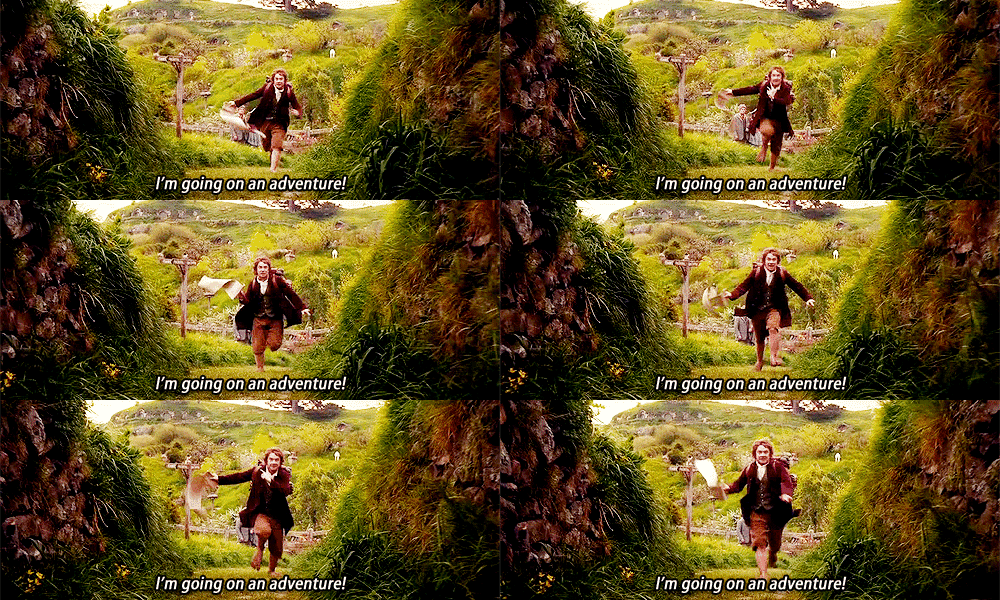
I dare anyone to make it through his books and not be in love with Middle Earth. From Hobbiton to The Lonely Mountain, to Ancient Númenor, Middle Earth is the mythical place I "miss" the most. And I confess that New Zealand is on my top 5 places I must go, because of the movies.
“He is a great enough magician to tap our most common nightmares, daydreams and twilight fancies, but he never invented them either: he found them a place to live, a green alternative to each day's madness here in a poisoned world. We are raised to honor all the wrong explorers and discoverers - thieves planting flags, murderers carrying crosses. Let us at last praise the colonizers of dreams.” ― Peter S. BeagleThe Tolkien Reader

2. Elves

People who know me were probably surprised that this isn't the first one on the list.
http://dalomacchi.deviantart.com/art/Brothers-in-Beleriand-289711180
©2012-2015 daLomacchi Brothers in Beleriand by daLomacchi on Deviantart.com
I want to be an elf. Specifically, one of Tolkien's elves. Wise, deadly, gracious, elegant, enigmatic - I think you get the point. A little bit of the Celtic fay folk, a little bit of every wise but dangerous counselor in fairy tales, and a dash of danger make Tolkien's elves THE BEST. Even when parts of The Silmarillion practically had me shouting at them in anger (I'm looking at you, sons of Fëanor!), it was only because I loved them so much.
'And it is also said,' answered Frodo: 'Go not to the Elves for counsel for they will answer both no and yes.'
'Is it indeed?' laughed Gildor. 'Elves seldom give unguarded advice, for advice is a dangerous gift, even from the wise to the wise, and all courses may run ill.” The Fellowship of the Ring

3.  Tolkien's Quiet Wisdom

I'll let him speak for himself here:

“There is more in you of good than you know, child of the kindly West. Some courage and some wisdom, blended in measure. If more of us valued food and cheer and song above hoarded gold, it would be a merrier world.” The Hobbit

“I wish it need not have happened in my time," said Frodo.
"So do I," said Gandalf, "and so do all who live to see such times. But that is not for them to decide. All we have to decide is what to do with the time that is given us.” The Fellowship of the Ring

“Deserves it! I daresay he does. Many that live deserve death. And some that die deserve life. Can you give it to them? Then do not be too eager to deal out death in judgement. For even the very wise cannot see all ends.” The Fellowship of the Ring

“War must be, while we defend our lives against a destroyer who would devour all; but I do not love the bright sword for its sharpness, nor the arrow for its swiftness, nor the warrior for his glory. I love only that which they defend.” The Two Towers

“It's like in the great stories, Mr. Frodo. The ones that really mattered. Full of darkness and danger they were. And sometimes you didn't want to know the end… because how could the end be happy? How could the world go back to the way it was when so much bad had happened? But in the end, it’s only a passing thing… this shadow. Even darkness must pass.” The Two Towers

“But I have been too deeply hurt, Sam. I tried to save the Shire, and it has been saved, but not for me. It must often be so, Sam, when things are in danger: some one has to give them up, lose them, so that others may keep them.” The Return of the King

“A man that flies from his fear may find that he has only taken a short cut to meet it.” The Children of Hurin

4. Tolkien's Love for Language and Words

http://www.buzzfeed.com/lorynbrantz/not-all-those-who-wander-are-lost#.arRMMY0by
Source


See #3 for examples. But what else would you expect from a philologist? The man was in love with language. And I have yet to read anyone who topped him in the invented languages department. It's more like he rediscovered something forgotten.

And speaking of languages - his translation of Beowulf is splendid (naturally). And if we're talking poetry and language, look at The Fall of Arthur, or The Legend of Sigurd and Gudrun.

And the Tengwar - so gorgeous! Source

5. HOBBITS

I personally think that Freeman is a fabulous Bilbo.

No tribute to Tolkien would be complete without mentioning the small, brave, and simple folk of the Shire. Bilbo, Frodo, Sam, Merry, Pippen - they're wonderful characters, and they have more heart and courage than most. And they really do appreciate the good things in life. I'd like to be an elf, but deep down, I know I'm more of a hobbit. I suspect that goes for all of us!
"Good morning!" he said at last. "We don't want any adventures here, thank you! You might try over The Hill or across The Water." By this he meant that the conversation was at an end."What a lot of things you do use Good morning for!" said Gandalf. "Now you mean that you want to get rid of me, and that it won't be good till I move off.” The Hobbit

6. All the Characters

From Tumblr.

I've mentioned elves and hobbits, but I haven't specifically mentioned Faramir, Eowyn, Boromir, Thranduil, Aragorn, Luthien, FINROD, Galadriel, Gandalf, Elrond, Elwing, and I could go on . . . Even the more evil characters (especially in the Silmarillion) are fascinating. And they're all epic. And epic = good.

7. The Aforementioned Values

“It is not our part to master all the tides of the world, but to do what is in us for the succor of those years wherein we are set, uprooting the evil in the fields that we know, so that those who live after may have clean earth to till. What weather they shall have is not ours to rule.” 
Tolkien had an immense appreciation for all that was great and good in the world: Courage, Honor, Duty, Fidelity. Call me Captain America, but I think we could use some more of it all. And Tolkien's characters always made me want to be noble, big-hearted, and selfless. There's a lot to be said for doing your best, being your best, and seeking the best in others.

8. Tolkien's Love for Nature


Tolkien was a self-proclaimed "tree-advocate." And all you have to do is read a few chapters of his works to see his love for the natural world. Just contrast the Elves and Orcs, and you'll see something interesting: Orcs rely on war machines and contraptions, while Elves tend and revere the earth. I don't know if I was always a nature girl, or if I can blame Professor Tolkien for that too, but it really doesn't matter. Tolkien was a great advocate of stewardship - of treating Creation with respect instead of taking it for granted. And I don't know if he really gets enough credit for that.

The leaves were long, the grass was green,
The hemlock-umbels tall and fair,
And in the glade a light was seen
Of stars in shadow shimmering. 


9. The Worldbuilding


He is the Master of Worldbuilding. See #1. In fact, I was actually thinking of Tolkien when I named this blog. He's the worldbuilder I aspire to be like.* Look at 1-8, and you'll see evidence of this. Middle Earth is so vivid and real that thousands of us are homesick for it.
“Home is behind, the world ahead,And there are many paths to tread
Through shadows to the edge of night,
Until the stars are all alight.
Then world behind and home ahead,
We'll wander back and home to bed.
Mist and twilight, cloud and shade,
Away shall fade! Away shall fade!”  

10. The Heart

I dare you to have dry eyes. One part that the movie did so well.
Again, I think this is pretty obvious from some of the other numbers on this list. But there is love for life, people, culture, history, lore, and all good things in Tolkien's writing. Don't believe me? Look at Sam Gamgee.
“Come, Mr. Frodo!' he cried. 'I can't carry it for you, but I can carry you and it as well. So up you get! Come on, Mr. Frodo dear! Sam will give you a ride. Just tell him where to go, and he'll go” The Return of the King

Honorable Mention: Tolkien's great appreciation for food. This shouldn't be undervalued, for sure.

So there you have it: My Top 10 Favorite Tolkien Things! Happy Hobbit Day! (Going to watch Return of the King now)

If you're a Tolkien fan, what's your favorite thing about him or his books? Feel free to gush away in the comments (I'll join you).


Footnotes:
*In case you wondered, the Wordsmith I thought of [when naming my blog] was Shakespeare.

Wednesday, May 20, 2015

Top 10 Fictional Worlds I'd Like to Visit (Top 10 Tuesday) (with reasons, gifs, footnotes, and theories as to why I'd leave)

It's Tuesday, which means it's time for Top 10 Tuesday with The Broke and The Bookish. For instructions on how to participate, click here.

Usually there is a theme for the list, but this week is a freebie, which means that we have all picked our own topic. My topic: The Top 10 Fictional Worlds I'd Like to Visit (with reasons, gifs, footnotes, and theories as to why I'd leave)

1. Middle Earth (from The Silmarillion, The Hobbit, and LOTR)

Image Credit
As soon as my feet touched that fantastical grass, I'd be off.
The Shire, Mirkwood, Rivendell, Lorien, and Rohan would be top of my must-see list.
Elves, dwarves, hobbits, food, the clothes, roughing it Fellowship style . . . why would you ever leave?

Image Credit


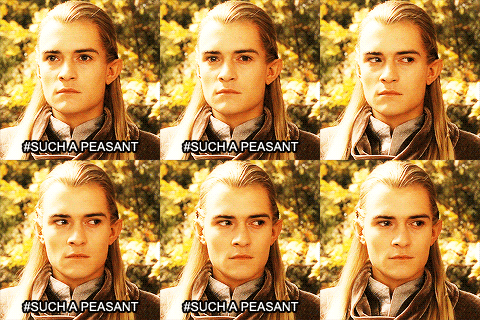
I have a theory: Basically, it would be like high school, where everyone in Middle Earth would be the "cool kids table," and I'd be that person who everyone felt kind of bad for, but still didn't let sit with them (you know the one, the one trying so hard to be all elvish and awesome, and failing miserably).

That, or I'd get eaten by a spider when I was in Mirkwood.


2. The Enchanted Forest (from the Enchanted Forest Chronicles by Patricia Wrede)

Artist: Peetasokka Image Credit
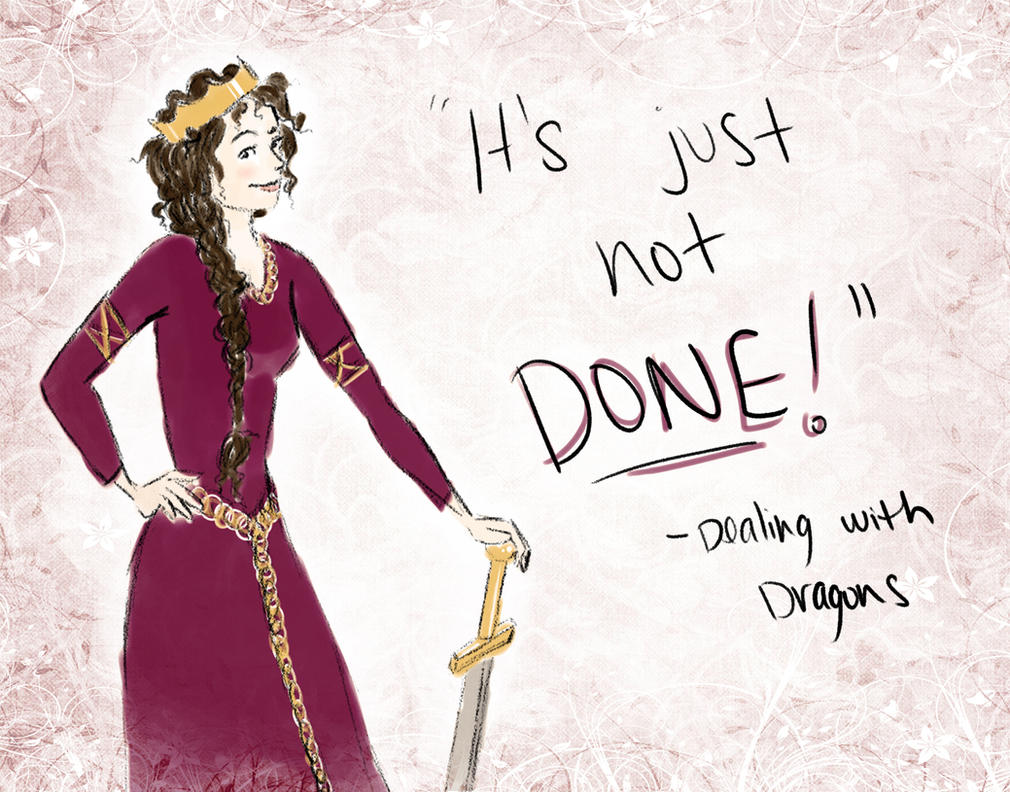
If I survived Mirkwood, I think a kindlier, more whimsical magic forest might be in order. Dealing with Dragons was (still is) one of my favorite fantasy novels, and it still cracks me up. Cimorene is a kindred spirit, and I would love to help her make buckets of cherries jubilee for the dragons. After that, I would do some exploring, and hopefully not run into any annoying wizards. I'd be sure to carry spray bottles of soapy water with lemon though, as a precaution . . .
.
Being polite, sensible, and not prone to eating random plants, I would probably get along just fine in this world. In the end, I'd probably leave because I'd want to see my family.

Image Credit

3. The alternate 1914 of Leviathan (Scott Westerfeld)

It's Clankers (they use machines) versus Darwinists (genetic manipulation) on the brink of World War I. Though there were parts of these books I didn't enjoy so much, I did love the crazy alternate world. It would be fascinating to explore! I would like to travel the world and compare it to actual 1914. I would probably end up leaving because I'd miss my writing and my books. As much as I like writing by hand, I'll take my laptop back, thank you very much.

4. Camelot (Gerald Morris edition)

Image Credit
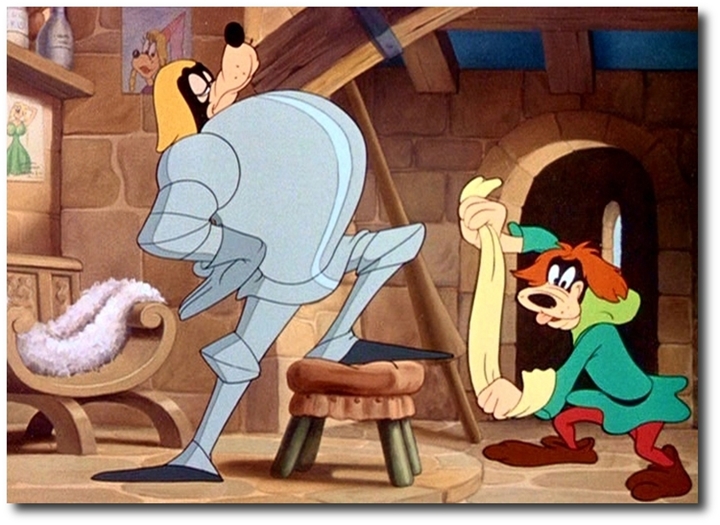
Knights, picking flowers?* I am a King Arthur devotee, in all seriousness. I write retellings, I will read almost anything Arthurian, and I have a passionate love/hate relationship with the stories themselves. That being said, Le Morte d'Arthur is incredibly depressing.** Gerald Morris took all that pathos and ran over it, with scissors and a crazy grin (metaphorically). His knights go on pointless quests, take vows of silence where all they do is talk, and stumble in and out of the Otherworld at random. It is hilarious, and yet it somehow manages to stay true to the spirit of the beloved stories. Also, his version is a little kinder to the ladies. I would probably stick it out here until I was cursed by wandering Fair Folk, or swallowed by an enchanted castle, or something. If I survived that, I'd probably head somewhere a little more "modern" next.

5. Early 1800's England-a la Jonathan Strange & Mr. Norrell (Susanna Clarke)

Image Credit
I sat here in a crisis of indecision over including this or Jane Austen's 19th century, only to realize that they were basically the same. But JS & MN has magic. As an American of average looks who is too fond of books and lacks sufficient funds, I doubt I'd have much chance at society (unless my book hopping came with magical powers?). Maybe I would just try to get a job as a servant? Perhaps I could pretend to be an heiress . . .

I would love to snoop on Strange and Norrell (though they'd probably discover me, non-magical person that I am). Assuming I didn't get tired of the mud or my inferior social status (or someone found out I was a fraud), I would explore this version of England until I felt too restricted (or until I got on the fairies' bad side, whatever happened first).

6. New Pacifica (Diana Peterfreund's Across a Star-Swept Sea***)

Image Credit
The islands of New Pacifica, Albion and Galatea, are stand-ins for London and Paris during the French Revolution. Across a Star-Swept Sea is a retelling of/tribute to one of my favorite novels, The Scarlet Pimpernel. Throw in crazy futuristic elements (the sea minks, the fashion, the tech), class unrest (they have good reasons), and a fascinating future world, and it is definitely a place I'd like to visit. The main thing I didn't like about the novel was the teen romance,**** but if I was exploring the islands, that would be a non-issue. And I really want to see all those lushly described island locations . . . (Pimpernel is a far superior novel, but I don't fancy visiting the actual French Revolution!).

 I'd fully intend on turning smuggler and helping to spirit people away from certain death. Which is how I'd end up leaving (what does happen if you die in a fantasy world?)

7. The Unwelcome Stranger (which is actually a ship in 1712 [seventeen twelvety] alternate timeline Earth)

Image Credit
Which brings me to piracy. Long before I understood the moral implications, I really wanted to be a pirate. It was one of my favorite things to play/pretend as a kid (after wood elves!). When I was a teenager, I discovered Tanith Lee's wonderfully strange pirate fantasy, Piratica. The pirates drink coffee (instead of rum), some of them are actually traveling players, and they really only rob other pirates (and follow silly treasure maps). In other words, it's all the fun of Treasure Island with none of the serious danger (or scurvy, which is more of a deterrent). I would happily take up with Art and her (mostly) daring crew of ne'er do wells. Always a restless wanderer myself, I'd sail their way until I remembered how badly I wanted an awesome horse.

8. That obscure Caribbean Island from Walter Farley's Island Stallion

I read everything with horses on the cover when I was younger. I always wanted a horse like the Black Stallion, or Black Beauty, or even the Chincoteague ponies. I would visit the Island and camp out until I got a really awesome horse (which I would somehow manage to smuggle back). If I couldn't keep the horse, I'd leave, heartbroken.

9. Discworld from Terry Pratchett's Discworld Series

They made a play in Chicago!
I confess that I haven't read every one, but if I had to pick, I'd join up with the Monstrous Regiment ladies, disguised as a man, naturally. Or I would try to have coffee with Death. Or maybe I would just explore the glorious, ridiculous world and talk to its inhabitants. Regardless, Discworld is full of adventure, satire, looniness, and general chaos. I think I would end up leaving because it made me exhausted (or overstimulated)!


10. Harry Potter's England

I'd want a job at Flourish and Blotts, or failing that, Weasley's Wizard Wheezes. I am not above sneaking into Hogwarts. My top priority would be the library! If I had the great good fortune to arrive and find I had wizardly gifts, I would be transported with delight. If not, I'm sure I could still have plenty of fun. One of the best parts of HP is the fabulous alternate world, existing right under Muggle noses. Diagon Alley almost holds more appeal than Hogwarts, if I'm honest, and I'd love to catch a professional Quidditch match. I think I would leave eventually, and maybe start back at Middle Earth?
Image Credit


Honorable Mentions: Narnia! (Chronicles of Narnia), New Beijing (Lunar Chronicles), Namid (Others Series), London Below (Neverwhere), The Well of Lost Plots (Thursday Next Series), I could go on forever. There were so many places that I'd want to go that I just went for variety in the end. 


It was hard to pick 10. However, I noticed that a lot of my favorite books weren't represented (I wouldn't really like to live in most of them, I suppose). As much as I love books like Rot & Ruin, The Haunting of Alaizabel Cray, or The Count of Monte Cristo, I am not ashamed to admit that I'd far rather read about a lot of things than live them!


What about you? Are there any fictional worlds you'd love to visit? Do you think you'd actually give up the real one for them (if you could)? How do you think you'd fit into your world choice? Tell me in the comments :)


Footnotes: 
*Actually from the soul-destroying (but hilarious) musical Camelot. Lancelot's disbelief seemed to fit here.
**I prefer the Celtic tales-less drama
***The companion novel, For Darkness Shows the Stars, is a retelling of Persuasion! I read these despite my dislike (loathing) for the author's other series. 'Nuff said, I'll keep it to myself.
****Despite the fact that it's in essence, a drippy (but not unbelievable) teen romance. I knew that going into it. It says a lot for the book that I liked it anyway.

Tuesday, April 21, 2015

Top 10 Tuesday via Broke and Bookish: Favorite Authors (with gifs)

And it's Tuesday-which means Top 10 Tuesday with the lovely people over at The Broke and the Bookish. Every week, they pick a theme for a top 10 list, and participating bloggers link back. You can find out more here.
This week's top 10-Top 10 Favorite Authors, was excruciating . . .
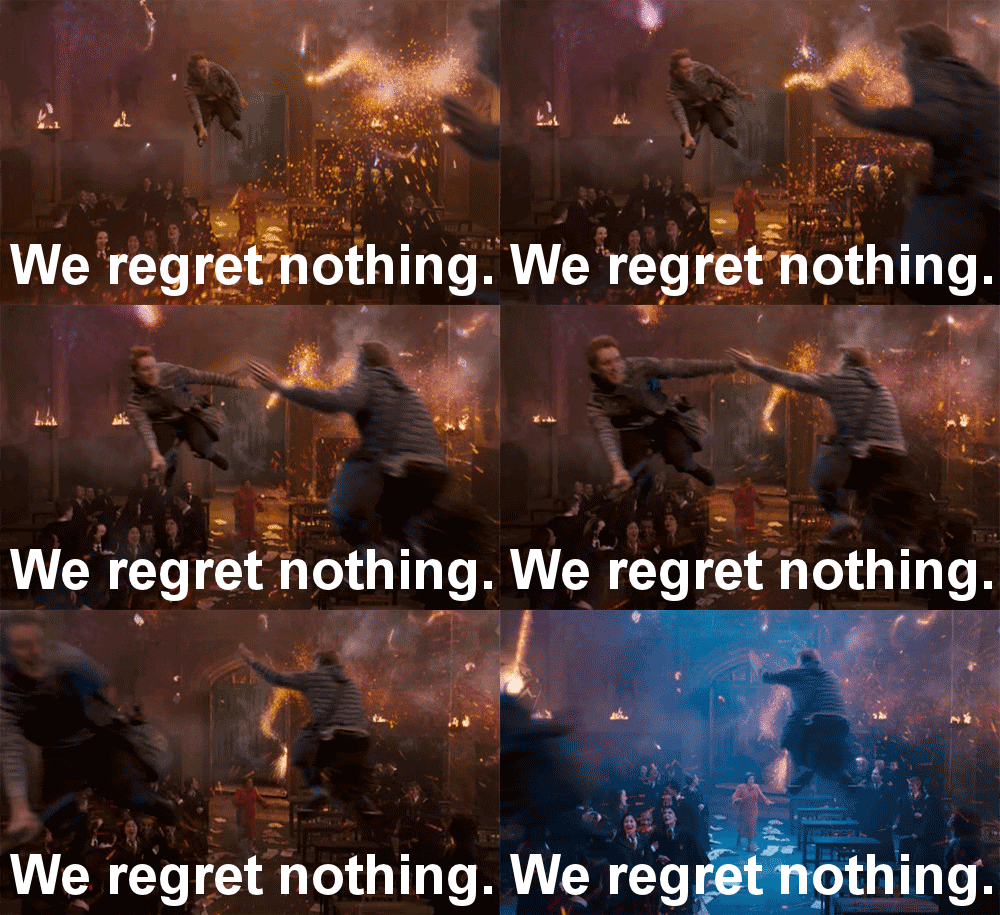
I know, Emma, I know.
Rather than agonize, grit my teeth, and lament, I decided to list 5 of my favorite "contemporary"* authors and 5 favorite "classic" authors, with two requirements:
  1. I have to have read at least 2 books by them
  2. I have to have reread at least 1 of their books/plays/whatever
Otherwise, this post might have taken me a couple years of re-reading and soul-searching.
But it all seriousness, this is really hard. So no more stalling, here it is:

 
  1. Classic: J. R. R. Tolkien
  2. Contemporary: Robin McKinley

I put them together because they are two of my earliest reading/writing influences. My dad read The Hobbit to us when we could hardly read ourselves (Thank you Dad!). Though some of the subtleties in Tolkien’s writing certainly escaped me as a kid, the beauty never did. I 100% blame him for my obsession with elves, my fascination with forests, and my dissatisfaction with so much of modernity.

Likewise, when I first read The Hero and the Crown, I was hooked. McKinley’s lovely use of language, her dreamy worlds, and her truly awesome heroines are still my favorite. As a teenager, I felt like her characters “got” me.

3. Classic: William Shakespeare
4. Contemporary: Neil Gaiman

Ah, Shakespeare; love him or hate him, or doubt he wrote his plays: I don’t care. He is hailed as the greatest writer in the English language for a reason. From made up words, to memorable characters, to owning tropes, Shakespeare was/is one of my biggest influences and rereads. “Good Lord, for alliance! Thus goes every one to the world but I, and I am sunburnt; I may sit in a corner and cry heigh-ho for a husband!” **

Neil Gaiman is properly paired with the Bard, because he is also a brilliant wordsmith and Master of Stories. I can’t exactly remember which book of his I read first, or when I first picked it up, because his characters and worlds have been a part of my reading life for so long. His ability to render character, atmosphere, and worlds with deft, spare prose, has this Dickensian girl gritting her teeth with writer-envy.

5. Classic: Jane Austen
6. Contemporary: Megan Whalen Turner

What can I say about Jane that hasn’t been said? If you don’t think Pride and Prejudice is funny, then read it again. I was a classic tomboy, but Jane had me on pins and needles as I wondered if Darcy and Elizabeth would ever do things right, or if Wentworth would realize he was misjudging Anne, or if Catherine Moreland’s gothic novel fantasies would ruin her shot with Henry. Not only was Jane brilliant and witty, but she made you care about her characters and their relationships. My anti-romance sentiments were forgotten every time I picked up one of her novels.
 
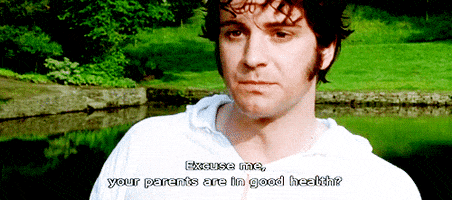
Austen tip #1: When flummoxed in front of someone you like, ask after their parents.
Megan Whalen Turner, if you don’t know, wrote The Queen’s Thief series. Eugenides, thief extraordinaire, and Irene, the strong and grim queen of Attolia, are two of my favorite characters (and couples) in all literature. The push/pull of their relationship, the scheming and court intrigue, the daring thefts, and the real consequences in these books made them impossible to put down. If I dare to skim for a favorite passage, I am always sucked into reading the whole book again. Now that, Ms. Turner, is a gift.

7. Classic: C. S. Lewis
8. Contemporary: Diana Wynne Jones

I actually prefer Lewis’s nonfiction (philosophy and theology) to his fiction. Don’t get me wrong, I love the Chronicles, and they are an integral part of my reading identity. But if I am naming off my favorites, The Four Loves and Till We Have Faces immediately spring to mind. The latter is fiction, being a retelling of the Cupid and Psyche myth, but the former is a slim volume packed with wit and insight on every kind of love. They actually go together quite well. Lewis’ wit, command of both history and mythology, and his affable professor writing voice, are at their best when he is writing about tough subjects like love and pain. In Till We Have Faces, he proved that he could write “serious” fantasy, and with a strong heroine, no less.


Diana Wynne Jones’ books are funny, smart, exciting, and so very English. Howl’s Moving Castle is one of my all-time favorites, and I pick it up whenever I need a good laugh. Sophie is another character I’ve always identified with. Her cleaning mania is pretty unique in YA fiction, I think. Another hilarious (but slightly darker) Jones novel, Dark Lord of Derkholm, is one of the better fantasy parodies out there. And she didn’t just write funny books, as the truly creepy Fire and Hemlock proved.

9. Classic: The Brontés
10. Current: Garth Nix

I am cheating and putting the Bronté sisters together. Not because they are all alike, but because I read their novels around the same time. Wuthering Heights made me furious at half the characters, but the novel is a masterpiece, nonetheless. Jane Eyre, likewise, deserves its place in the pantheon of English literature. Mr. Rochester frustrated me too, but Jane’s spirit and strength of character makes her one of my favorite heroines. And of course, the oft-forgotten Anne Bronté wrote too! The Tenant of Wildfell Hall does not get as much credit as it deserves.


Garth Nix’s Abhorsen series is one of my all-time favorites. Sabriel is one of the coolest heroes ever, and the idea of anti-necromancers was brilliant. I love everything about Sabriel, from Sabriel’s no-nonsense attitude, to the use of bells to command the dead, to the world, to funny, bitter Touchstone and aggravating Mogget. Like every author on this list, Nix has a way with language that pulls you write into his worlds. From the first scene, where Sabriel brings back a pet rabbit from death, I can never put this one down once I start reading.


This is where it got hard: Terry Pratchett, Elizabeth Marie Pope, Edgar Allen Poe, Patricia C. Wrede, Ray Bradbury, Agatha Christie, Erik Larson, Matthew Pearl, The Brothers Grimm, Louisa May Alcott, Charles Dickens, D. M. Cornish, Jonathan Maberry, Patricia McKillip and more kept intruding. I could do this list indefinitely . . .

Footnotes: 
*I am defining Contemporary as "actively writing from 1980's and on :)"
** Beatrice, we have all been single at a wedding (I think), made some witty, sarcastic aside, and been taken seriously. Beatrice is my spirit animal.

So, did I pick any of your favorites? Tell me in the comments :)

Wednesday, January 21, 2015

Post-Reading-Tolkien Syndrome

(Note: This silly post was originally published on this wonderful blog http://www.shealynns-faerie-shoppe.blogspot.com/  in September of 2012. I thought it was worth a re-post.)

A Few Suggestions for the Effective Treatment of Post-Reading-Tolkien Syndrome


    Do you ever look outside, and wish that there were elves passing through your backyard?
    Do you watch the latest fantasy film and decide it’s just not good enough?
    Do you see mossy knolls and think, “Wouldn’t that make the cutest little Hobbit hole?”

       If you answered yes to any one of these questions, you might have Post-Reading-Tolkien Syndrome (or PRTS for short). PRTS is an uncomfortable condition, and cannot be treated by the medical community. As a sufferer of PRTS myself, I've compiled a list of helpful suggestions and activities to soothe the discomforts brought on by PRTS, and bring you back to reality with a gentle push, not a shove.


  1. First, to get yourself in the right frame of mind, you should brew a cup of tea, and bake/purchase some Lembas or Seed Cakes. If, like me, you haven’t found a working recipe for Lembas yet, you can substitute shortbread-it looks right.
  2. Listen to some music while you bake. Here are a few suggestions:
If you can’t find any of these albums or artists, just put on a Howard Shore or Celtic Internet radio station.

     Now that you have taken care of the music and the victuals (wise preparations for any adventure), you have to find another book to read. This can be a very difficult, and sometimes painful process, and you will need the music and food to fortify you. Reading any masterwork can make other books seem sub-par (or reveal the truth, if you will). So you have to let yourself down slowly. Here are some suggestions to make it easier on yourself:

If you just read The Hobbit, and are looking for light adventure fare with deep themes, read The Chronicles of Narnia or The Princess and the Goblin, or Susan Fletcher’s Dragon Chronicles. You also might try Christopher Paolini’s Eragon. If you are a young Tolkien fan and wish there were more books with fantastical places and creatures, try the Fablehaven series or Beyonders: A World Without Heroes, both by Brandon Mull, or the Redwall series.

   If you read The Lord of the Rings Trilogy, and need another series with a returning king and unlikely heroes, read Lloyd Alexander’s Chronicles of Prydain or The Monster Blood Tattoo Trilogy by D. M. Cornish (not nearly as silly as it sounds-with a very Tolkien feel!).
   If you’re feeling more epic size and fantasy to boot, also read Jonathan Strange and Mr. Norrell, by Susanna Clarke-which is an amazing book on its own. If you’re on the younger end, or more interested in humans, try the Ranger’s Apprentice Series by John Flanagan.

   If you read the Silmarillion, The Lost Tales, or Unfinished Tales, and need more dreamy locales, bittersweet endings, epic romances, legendary heroes, and/or magic, try The Forgotten Beasts of Eld, by Patricia A. McKillip, The Hero and the Crown or Chalice, Robin McKinley, the Abhorsen Trilogy by Garth Nix, Til We Have Faces, by C. S. Lewis, Le Morte D’Arthur, or The Perilous Gard by Elizabeth Marie Pope.

   If you read The Legend of Sigurd and Gudrun, try Beowulf, retro (pre 90’s) Thor comics (I’m serious),  Rosemary Sutcliff’s Historical Fiction, Ursula Le Guin’s Earthsea Series, The Song of Roland, Susan Cooper’s The Dark is Rising series, Patrick Rothfuss' The Name of the Wind, Stephen R. Lawhead’s The Dragon King Trilogy, Sir Gawain and the Green Knight (translated by Tolkien!) or good old collections of Norse Mythology.

   If you read Smith of Wootton Major or Farmer Giles of Ham, try Grimm’s Fairy Tales, Patricia Wrede’s Enchanted Forest Chronicles, T. H. White’s The Sword in the Stone,  or Cornelia Funke’s Inheart.

   If you read Roverandom, try Andrew Peterson’s Wingfeather Saga, Neil Gaiman’s Odd and the Frost Giants, or N. D. Wilson’s 100 Cupboards Trilogy.

   If you read any or all of the above, or if you need to laugh, hard, I would also recommend The Dark Lord of Derkholm by Diana Wynne Jones and Gerald Morris’s The Squire’s Tales (Arthurian mischief and humor).

And finally, if reading a book is too hard right now, here are five more activities to ease your Post-Reading-Tolkien Syndrome:


  1. Walk through a forest at twilight
  2. Watch a movie like Thor, a miniseries like the 10th Kingdom, or a TV show like Once Upon a Time.
  3. Look at Alan Lee’s and J. W. Waterhouse’s art books, or visual guides to England, Ireland, Scotland, or Wales.
  4. Write a story about Elves, Dwarves, or anything else you wish was (or wasn't) real.
  5. Phone a similarly suffering friend and commiserate, then do any of the above activities together.

From one sufferer of PRTS to another, I hope these suggestions help you on your road to recovery.

R. L. Hendrian
Pioneer in the study of PRTS and its effects.